As a supplier, at least part of your team’s day revolves around retailer portals. Home Depot. Costco. RONA. Canadian Tire. Each one has its own login and expectations for how orders are managed.
It often means jumping between browser tabs and NetSuite just to keep orders flowing, which means that as volumes multiply, portal work grows faster than your team can keep up. And it’s usually only when order volumes spike, new retailers come on board, or chargebacks begin to pile up that leadership finally asks: Is this really what EDI is supposed to look like?
The short answer: no. But the longer answer explains a lot about why so many suppliers feel stuck.
What EDI Portals Actually Are
Retailer EDI portals, often called “Web EDI”, are web interfaces where suppliers manually log in to view, download, or upload EDI documents.
The retailer generates EDI files (850s, 856s, 810s, etc.), but instead of sending those files directly into your system (like NetSuite), they publish them to a portal so suppliers can retrieve them manually.
Portals are an access method, not an EDI integration,which means that teams are effectively acting as the “middleware” between the retailer and NetSuite.
How Portal-Based EDI Became the Default
Most suppliers don’t choose portals strategically. Instead, the first big retailer says, “You need to use our portal to access orders.” The second retailer says the same. By the time the third arrives, portal tasks have quietly become a daily routine.
The strain becomes obvious when:
● Orders don’t enter your NetSuite until someone manually retrieves them
● Your team spends most of their day navigating orders from multiple portals
● Seasonal spikes overwhelm the team
Why EDI Portals Quietly Increase Operational Costs
The fundamental problem with portals isn’t complexity. It’s repetition. Hour after hour, teams bounce between browser tabs and NetSuite, copying data from one system into another.
The swivel-chair tax
Every retailer portal adds a new version of this workflow:
1. Log in
2. Look for new orders
3. Download files or copy information
4. Re-enter the data into your NetSuite
5. Build ASNs manually
6. Upload shipment details
7. Generate and submit invoices
Because the work is spread across several people and portals, the labor cost stays invisible which makes it difficult to quantify just how much manual work portal-driven EDI actually requires.
The truth is that portals aren’t really EDI at all. They’re a web interface showing you EDI data that your team is expected to interpret, structure, and enter correctly.
Portals create a parallel workflow
NetSuite has a workflow. Your warehouse has a workflow. Your shipping systems have workflows…. And your retailer’s portals don’t speak the same language. All this introduces a siloed workflow that lives outside all of them.
You end up running two operational universes:
1. Orders that sync inside NetSuite
2. Orders that must be pulled manually out of retailer portals
Because portals live outside your systems, they never show up until a human has copied the data over, making it impossible to truly understand demand in real time.
Want to calculate the ROI of automating EDI? Try the EDI Automation ROI calculator.
3 Ways Modern EDI Bridges the Portal Gap
Modern EDI integration isn’t just about transmitting documents. It’s about eliminating the manual interpretation and re-entry work that portals create. A modern EDI platform sits between the retailer and your ERP, delivering documents as structured, validated, NetSuite-ready data.
1. It turns portal-originated orders into structured NetSuite data
The first shift is conceptual: stop treating portal data as “screens people read” and start treating it as data systems can process. Modern EDI captures the same information your team retrieves manually, transforming it into structured, validated, ERP-ready data.
The flow becomes:
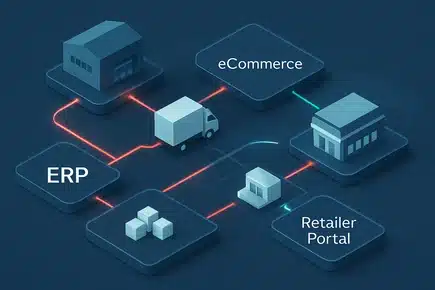
Retailer → Data feed → Modern EDI → NetSuite
Your team remains in control, but their time goes toward decision making and account expansion.
2. It uses pre-built configurations
Historically, onboarding each retailer meant custom mapping and months of coordination.
Modern EDI platforms come with retailer configurations already built, tested, and maintained. Retailers like Ace Hardware, Petco, and Macy’s become automated trading connections.
When retailers update specs, the integration layer absorbs the change. Your team doesn’t bear the burden.
3. It creates one automation layer for all B2B orders
The most powerful outcome is consolidation.
Portals, email orders, marketplaces, B2B eCommerce, all flow into a single automation layer. Everything is normalized. Everything follows the same validation rules. Everything enters your ERP in a uniform format.
This gives you:
● One view of demand
● One source of truth
● One predictable workflow
● One system governing order quality
How OrderEase Makes EDI Flow Seamlessly Into NetSuite
Most suppliers feel the strain of portal-based EDI long before they feel the benefit. Orders sit in Costco, RONA, or Home Depot portals until someone retrieves them, and validates everything before it finally reaches NetSuite.
OrderEase removes that entire layer of manual effort.
Instead of your team acting as the “bridge” between retailer portals and NetSuite, OrderEase becomes the system of action that turns every retailer’s requirements into structured, NetSuite-ready data your system understands.
Here’s what that looks like in practice:
● Portal orders flow directly into NetSuite as clean sales orders (no copy/paste, no CSV uploads, no re-keying).
● ASNs and invoices are generated automatically based on your NetSuite fulfillment and billing workflows.
● Retailer-specific rules (RONA, Costco, Canadian Tire, Home Depot, and others) are already built into OrderEase’s automation layer, eliminating one-off configurations.
● All order channels (EDI, email, marketplace, B2B portal) follow the same data structure, so NetSuite becomes the single source of truth.
The result is a NetSuite order management workflow that works as it was intended: real-time visibility, consistent data, and predictable workflows. For growing suppliers, this creates a scalable foundation: as you add new retailers or volumes surge seasonally, NetSuite simply keeps up.
Moving Beyond Portal Survival Mode
Retailer portals were never designed to handle the full weight of supplier operations. As portals multiply, they introduce hidden labor, duplicate workflows, and operational blind spots.
Modern EDI software doesn’t eliminate portals. It simply puts them back in their proper place: as an access point, not a manual workflow.
When data flows cleanly, people can focus on meaningful work; teams move faster, visibility improves, and volume becomes fuel. For modern suppliers, that’s what growth should feel like.